MHSA – About Us
Meet the Faculty & Staff
Dean, Anesthesiologist Assistant Programs
Michael Nichols, CAA, MS, MBA, serves as the Dean of the MHSA program, bringing 25 years of clinical and educational experience to his leadership. Originally from Cleveland, Ohio, Michael now resides in Cumming, Georgia. He earned a Bachelor of Science in Biology from the University of Dayton in 1998, a Master of Science in Anesthesia from Case Western Reserve University in 2000, and an MBA in Analytics from the University of Dayton in 2019. He is currently pursuing a PhD in Education from Liberty University.
As Dean, Michael is passionate about supporting both students and faculty and is especially inspired by the opportunity to teach and mentor future CAAs. He believes that success in the program starts with the right mindset, one grounded in growth and grit.
A strong advocate for the profession, Michael also holds the distinct honor of being the first non-physician appointed to the Executive Board of the American Society of Anesthesiologists Political Action Committee. Outside of work, Michael enjoys golfing, playing tennis, and spending time with his wife, Abby, and their three boys: Aidyn, Liam, and Lincoln. Along with their two doodles, Maeve and Scarlett, they ensure there is never a dull, or quiet, moment at home.
Executive Assistant to the Dean
Madison Corbin serves as the Executive Assistant to the Dean for the MHSA program. Originally from Birmingham, Alabama, Madison moved to Auburn to attend Auburn University in 2020 where she earned her Bachelor of Science in Nutrition in 2023. Following her undergraduate degree, Madison completed her Masters in Higher Education from Liberty University in 2026. In her role, Madison supports the program’s daily operations and cross-campus collaboration.
Madison loves working alongside the dedicated MHSA team to foster an environment where faculty, staff, and students feel supported and valued. She believes in the importance of strong communication.
Outside of work, Madison enjoys baking, walking her dog, and spending quality time with her family. She and her husband, Daniel, live in Opelika with their dog, June. Madison loves to make meaningful connections with others and to make sure they feel valued and supported!
Network Directors
Director for Academic Success
Dr. Jessica Milton serves as the Director of Student Academic Success for the MHSA program at both the Auburn and Spartanburg campuses through the Virginia College of Osteopathic Medicine’s Center for Faculty, Student, and Institutional Support (CIFSS). Originally from Selma, Alabama, she moved to Auburn for college and has proudly called it home ever since.
Jessica earned her PhD in Rehabilitation and Special Education, with a focus on Disability Studies, from Auburn University in 2020. She also holds multiple certifications in Educational Leadership, Administration, and Collaborative Special Education. With over 12 years of experience in education, she brings expertise in academic intervention, inclusive practices, and student-centered support. From building study plans to coordinating support systems for struggling students, Jessica’s mission is to empower learners with the tools they need to succeed while never losing sight of the human behind the transcript.
Outside of work, Jessica enjoys baking, gardening, reading, and spending time at Lake Martin with her husband, Clay, and their two daughters, Lucy and Frances. She serves on the vestry at her church and is actively involved in the PTO at her daughters’ school. She is an avid reader, amateur baker, and wannabe beekeeper.
Associate Dean for Student Affairs
This staff member’s bio is currently unavailable. Check back soon!
Director of Medical Education
Ellen serves as the Director of Medical Education at both the Auburn and Carolinas campus. She is originally from Pelham, AL and came to Auburn for college in 2013 and has called Auburn home ever since.
She earned her undergraduate degree in Rehabilitation and Disability Studies and a master’s degree in School Counseling. She served as a school counselor for several years before joining VCOM as the Director of Admissions. Her progression from counseling to admissions to higher education leadership reflects her talent for combining student-centered service with organizational excellence. In her role as Director of Medical Education, Ellen oversees and supports the daily operations of medical education across both the Auburn and Carolinas campuses. She is responsible for supervising teaching and exam processes, coordinating course materials, maintaining academic calendars, and supporting both students and faculty in the learning environment.
Outside of work Ellen enjoys spending time with family, attending Auburn sporting events, and going to the lake. Ellen lives in Auburn with her husband Matt, son Jack Thomas, and dog Otis.
Auburn Faculty & Staff
Medical Directors
Medical Director
Dr. J. Gary Bridges, DO, FASA, serves as the Medical Director for the MHSA program and is a practicing staff anesthesiologist at East Alabama Medical Center. A native of Vidalia, Georgia, Dr. Bridges earned his degree in pharmacy from the University of Georgia in 1984 before completing his Doctor of Osteopathic Medicine at the West Virginia School of Osteopathic Medicine in 1992. He went on to complete his residency in anesthesiology at the University of Alabama in 1996 and has been in active clinical practice ever since.
Dr. Bridges is deeply passionate about educating the next generation of anesthesia providers, especially as the field continues to grow in Alabama. He values the curiosity and commitment of MHSA students and finds great purpose in supporting their journey into the profession.
In addition to his clinical and academic roles, Dr. Bridges serves as President of the Alabama State Society of Anesthesiology and Chief of Staff at East Alabama Medical Center. Outside of medicine, he enjoys cheering on UGA football, exploring the outdoors, and traveling with his wife, Sandy Bridges, M.Ed.
Medical Director
William (‘Will’) Potter is a Georgia native and currently serves as the Co–Medical Director of the program and is based at Northeast Georgia Medical Center. After graduating from the University of Georgia, Dr. Potter received his medical degree from the Medical College of Georgia and then a Master of Healthcare Administration from the University of Alabama Birmingham. He completed his anesthesiology residency and regional anesthesia fellowship at UAB and joined the Anesthesia Associates of Gainesville in 2019. In his role as Co–Medical Director, Dr. Potter oversees the learning curriculum for students rotating in the Northeast Georgia region, is a member of the Division of Clinical Affairs, serves on the Admissions and Programmatic Effectiveness Committee, co–chairs the Educational Content Subcommittee of the Advisory Council, and is the Course Director for the Capstone Project in Quality Improvement.
Program Director
Associate Dean for Academic Affairs
Program Director
Gary Jones, CAA, serves as the Associate Dean for Academic Affairs and Program Director for the Auburn Campus of the MHSA program. Originally from Syracuse, New York, Gary is a seasoned educator and clinician who brings more than two decades of experience in anesthesia and academic leadership. He began his academic journey at the United States Naval Academy (Class of 1991) and went on to earn degrees from Syracuse University, Binghamton University (BA in Biology, 1997), and Case Western Reserve University (MS in Anesthesia, 1999). He has also completed coursework in Adult Education and Curriculum Design at the University of Georgia and is currently pursuing a doctoral degree in Higher Education Administration with a focus on Organizational Leadership at Liberty University.
Practicing as a Certified Anesthesiologist Assistant since 1999, Gary is passionate about the lasting impact MHSA graduates will have on healthcare. “Each of our students will care for nearly 1,000 patients annually,” he shares. “Knowing I play a small part in touching that many lives makes this work deeply meaningful.”
Outside of the classroom and clinical setting, Gary enjoys tinkering on his small farm and fly fishing in the wide rivers of Montana.
Assistant Program Directors
Assistant Program Director of Clinical Affairs
Originally from Los Angeles, California, Ralph Dapaah currently serves as Chief Anesthetist with Anesthesia Associates of Gainesville, where he specializes in Cardiothoracic and Obstetric Anesthesiology. He completed his Masters of Health Sciences in Anesthesiology at Nova Southeastern University in 2011 with honors and subsequently earned the Chancellor’s Award. Currently, Ralph serves on the American Academy of Anesthesiologists Assistants (AAAA) as a member of the Board of Directors. He previously served as President of the Georgia Academy of Anesthesiologist Assistants (GAAA), and as a board member of GAAA. His involvement in both the state and national level anesthesia academies has always been his passion along with academia. His hobbies include playing multiple sports, wake surfing, snowboarding, going to the beach, attending concerts, and being a huge foodie.
Assistant Program Director of Academic Affairs
Michael Fleming, MMSc, CAA, serves as the Assistant Program Director for Academic Affairs at the PDAA campus and is also a faculty member, teaching didactic and clinical courses to students in the MHSA program. A native of Huntsville, Alabama, Mike earned his Master of Medical Science in Anesthesia from Emory University and has been practicing as a Certified Anesthesiologist Assistant for over 26 years.
He values the opportunity to connect with students daily and finds great meaning in helping them grow into capable, compassionate anesthesia providers. His decades of clinical experience bring real-world insight to the classroom and beyond.
Outside of work, Mike enjoys family travel, playing pickleball, and spending time outdoors. His wife, Monique, works as a travel advisor, and the two enjoy planning memorable getaways together, always chasing their next adventure.
Assistant Program Director of Simulation
Matthew Noonan splits his time between Vero Beach, FL, and Opelika, AL. He earned his BS in Cardiopulmonary Sciences from Northeastern University and his Master’s in Anesthesia from Emory University. Matthew is currently a doctoral candidate at Northeastern University, focusing on Healthcare Leadership. With over a decade of experience as a CAA, Matthew finds the work fulfilling because it rarely becomes routine and always offers something new to learn. Outside of work, he enjoys sport shooting, fishing, and golf. An animal lover at heart, Matthew often jokes that moving frequently has kept him from having a house full of pets.
Staff Directors
Director of Simulation
Jacob Adams, NRP, CHSE, serves as the Director of Simulation Education for the MHSA program, where he designs and facilitates immersive, hands-on learning experiences to prepare students for clinical success. Originally from Wadley, Alabama, Jacob moved to Auburn in 2022. He holds an Associate of Applied Science in Emergency Medical Technology (2020) and a Bachelor of Science in Psychology and Christian Counseling (2023).
Jacob values the opportunity for mentorship and connection, sharing that one of the most rewarding parts of his role is walking alongside students and encouraging them through both challenges and growth.
Outside of work, you will often find Jacob relaxing in a local coffee shop, working on creative projects, or spending time with loved ones. He shares his home with his loyal dog, Charlie, always eager for a ride or a walk, and his low-maintenance but beloved fish, Mark.
Director of Clinical Rotations
Dan Jansen serves as the Director for Clinical Rotations for the MHSA program, where he provides support to students from orientation through graduation. Originally from Fordyce, Nebraska, Dan now resides in Fortson, GA. Dan retired from the US Army after 20 years of service. He earned a Bachelor of Science in General Studies from the University of Nebraska Omaha, a master’s degree in Geological Engineering from Missouri Science and Technology, and a master’s degree in strategic studies from Command and General Staff College in Fort Leavenworth, KS.
Outside of the office, Dan keeps busy coaching his children’s baseball and softball teams. He lives in Fortson with his wife Joan, and their four children Josie, Kaydance, Hunter and Chance.
Director of Student Affairs
Paige Oglesby, MEd, serves as the Director for Student Affairs for the MHSA program, where she provides holistic support to students from orientation through graduation. Originally from Enterprise, Alabama, Paige moved to Auburn in 2012. She earned her Bachelor of Science in Health Administration from Auburn University in 2016 and her Master of Education in Student Affairs in Higher Education from the University of West Alabama in 2021.
Paige is passionate about student development and mentorship. Her favorite part of the job is witnessing each student’s personal and professional transformation over the course of the 28 month program. Each student’s journey is different, but watching who they become by graduation is one of the most rewarding parts of her work.
Outside of the office, Paige enjoys exercising, reading, and sewing. She lives in Auburn with her husband, Kole, and their four children, Walker, Jensen Jane, Vaughn, and Murphy.
Director of Admissions
Annabel Tipold serves as the Director of Admissions for the MHSA program, overseeing the admissions process to attract and admit a strong and diverse group of individuals. Originally from West Newbury, Massachusetts, Annabel earned her BA in Psychology at Auburn University in 2021. Annabel is dedicated to supporting students as they take the next step in their education, ensuring they feel valued and guided throughout the admissions process. Outside of work, she enjoys reading, baking, and getting coffee. Annabel lives in Opelika with her husband, Cade, and their golden, Watson.
Administrative
Administrative Assistant
Cristina Allen serves as the Administrative Assistant for the MHSA program, supporting both students and faculty to help create a smooth, efficient, and encouraging environment for everyone to succeed. Originally from San Salvador, El Salvador, Cristina moved to Lanett, Alabama, in June 2025. She earned her Bachelor of Science in Graphic Design with a minor in Photography from Troy University in 2017.
Cristina is passionate about fostering a welcoming space for students and enjoys being part of a team that is dedicated to their growth and success.
Outside of work, Cristina enjoys cooking, hiking, and playing board games with her family. She lives in Lanett with her husband, Eric, their two young children, Augi and Belle, and their dog, Ti.
Medical Education Specialist
Fran Burke, BSW, serves as a Medical Education Specialist for the MHSA program, where she provides essential support to both students and faculty throughout the academic journey. Originally from Montgomery, Alabama, Fran moved to Auburn in 2013 and earned her Bachelor’s in Social Work from Auburn University in 2017.
Fran’s favorite part of her role is interacting with students, building connections, and being a steady presence as they navigate their education and clinical training.
Outside of work, Fran enjoys anything that involves time with her children, cheering on Auburn sports, and organizing just about anything she can get her hands on. She lives in Auburn with her husband, Jeremy, their two children, Harper and Holden, and their chocolate lab, Khai.
Program Faculty
Assistant Professor of Anatomical Sciences
Dr. Daniel Cawley, DC, MS, MSHS, serves as an Assistant Professor of Anatomical Sciences in the MHSA program. Originally from Savannah, Georgia, he has called Opelika home since 2021. Dr. Cawley holds a Bachelor of Science in Nutrition Science from the University of Georgia, a Doctorate of Chiropractic and Master of Science in Sport Health Science from Life University, a Master of Science in Biology from Georgia State University, and a Master of Science in Imaging from the University of Edinburgh.
He enjoys getting to know students and guiding them through the complexities of anatomy, always encouraging growth both in and out of the classroom.
Outside of work, Dr. Cawley enjoys exercising, hiking, and camping. He lives in Opelika with his wife, Rebecca, and their two children, Coltyn and AnnaMae.
Program Faculty
Katie Hunt, MHSc, CAA, serves as a faculty member in the MHSA program, where she draws on her clinical expertise and academic experience to support the next generation of Certified Anesthesiologist Assistants. A native of Atlanta, Georgia, she earned her Bachelor of Arts in French from Davidson College in 2007, followed by a Master of Health Science in Anesthesia from Nova Southeastern University in 2009. Katie has been practicing as a CAA since 2015.
One of her favorite aspects of teaching is witnessing the light bulb moments, when students connect multiple concepts and everything suddenly clicks. She finds great fulfillment in guiding learners through that process of discovery and confidence building.
Outside of work, Katie enjoys traveling, gardening, and curling up with a good book. She lives in Chamblee, Georgia, with her two dogs, Glavine and Maddux. Fun fact: anesthesia runs in the family, Katie works alongside her father, who is also a CAA.
Program Faculty
Craig Cox, CAA, serves as a faculty member in the MHSA program, bringing both clinical expertise and a passion for teaching to the classroom. Originally from Homerville, Georgia, Craig has called Athens home since 2008. He earned his Bachelor of Science in Biology from the University of Georgia in 2010 and went on to complete his Master of Science in Anesthesia at Nova Southeastern University in 2018.
Craig’s favorite part of the job is simple, the people. He values the relationships built with students, colleagues, and fellow providers and believes those connections are what make the work truly meaningful.
Outside of work, Craig enjoys cooking, skiing, and reading. He lives in Athens with his wife, Heather, and their dog, Bond.
Program Faculty
Dr. Gary Mount graduated in 1990 with a BS in pharmacy from Auburn University; in 2006 with his PharmD from the University of Florida, Magna cum Laude and recognized with a Superior Academic Achievement Award. Gary is married to Fatima, and they have three children Zack, Nick, and Gabby, and two daughters in law, Merry and Ilga. Gary has served as a staff pharmacist, clinical pharmacist, assistant director and director of a small hospital, and director of the pharmacy for a large institution for eleven years, where he provided strategic leadership for 80 employees. Gary’s retail experience has been in the chain and independent and as director of an independent. Having worked in many settings, Gary has a broad view of the pharmacy profession. Currently, Gary is an Assistant Pharmacology Professor at Edward Via College of Medicine, where he lectures on all body systems and conducts research with a special interest in pharmacogenomics.
Program Faculty
Renee McAlindon, MS, BSN, RN, CAA, serves as a faculty member on the Auburn Campus, returning to the program as a recent graduate who exemplified academic excellence, professionalism, and servant leadership during her time as a student.
Before pursuing anesthesia, Renee spent nearly two decades as a registered nurse, caring for patients across a wide range of specialties including orthopedics, perianesthesia, trauma, and case management. She now practices clinically as a Certified Anesthesiologist Assistant at East Alabama Medical Center and enjoys mentoring students and helping them develop both the technical skill and compassionate approach to patient care that defined her own journey through the program.
Renee resides in Auburn, Alabama with her husband and pups!
Program Faculty
Garrett Stein, CAA, serves as a faculty member on the Auburn Campus, where he brings both clinical experience and a strong personal connection to the program as a graduate of its inaugural class. During his time as a student, Garrett distinguished himself through his professionalism, intellectual curiosity, and commitment to teamwork, and he began supporting the program as a guest lecturer and skills assistant even before completing his own training.
Clinically, Garrett practices as a Certified Anesthesiologist Assistant at East Alabama Medical Center. He teaches Pathophysiology to first-year students and enjoys helping learners connect foundational science concepts to real-world clinical practice, while mentoring students as they progress through the same program that helped shape his own career.
Outside of work, Garrett enjoys life in Auburn, Alabama, with his wife and their young children.
Carolinas Faculty & Staff
Medical Directors
Medical Director
This staff member’s bio is currently unavailable. Check back soon!
Medical Director
Dr. S. Kim, DO, MPH, PharmD, FASA, FASRA, serves as the Co-Medical Director for the MHSA program at the Carolinas campus. With a diverse academic background and a deep commitment to medical education, Dr. Kim brings both clinical excellence and a passion for mentorship to his role. He earned a Bachelor of Science in Chemistry from Emory University (2002), a Doctor of Pharmacy from the University of Florida (2006), and a Doctor of Osteopathic Medicine from Nova Southeastern University (2013).
Dr. Kim finds joy in teaching and mentoring future anesthesia providers and encourages students to remain open to learning from everyone they encounter, peers, patients, and professionals alike.
Outside of his clinical and teaching responsibilities, Dr. Kim enjoys sporting clays, calisthenics, and playing the guitar. He lives with his wife, their two children, and two dogs.
Program Director
Program Director
Megan Varellas, CAA, MMSc, serves as the Program Director for the MHSA program at the Carolinas campus. Originally from Asheville, North Carolina, Megan has spent her career deeply rooted in the practice and advancement of anesthesia education. She earned her Bachelor of Science in Biology from Wofford College in 1991 and her Master of Medical Science from Emory University School of Medicine in 1993. With over 30 years of clinical experience, she brings a deep understanding of the science behind anesthesia, and a love for sharing it.
Megan is passionate about cultivating clinical excellence and encourages students to adopt a mindset of lifelong learning, always striving to improve their knowledge and skills in an evolving field.
Outside of her professional life, Megan enjoys riding and caring for her horses, gardening, and reading. She lives in Asheville with her husband, Patrick, and their animal crew, which includes horses, Catcher, Sure Hit (affectionately known as Monkey), and Davino, and their dogs, Seamus, Pixie (aka Pigpig), and Olive.
Assistant Program Directors
Assistant Program Director of Academic Affairs
Kirk DeWitt, CAA, serves as the Assistant Program Director for Academic Affairs at the MHSA program’s Carolinas campus. Originally from Savannah, Georgia, Kirk now lives in Columbia, South Carolina. He earned a Bachelor of Science in Pharmacy from the University of Georgia in 1987 and completed his Master of Medical Science in Anesthesia at Emory University in 1995.
With 30 years of clinical experience as a CAA, Kirk brings a steady hand and seasoned perspective to both the classroom and the clinical setting. He finds great fulfillment in watching new students grow into confident, skilled anesthesia professionals.
Outside of work, Kirk enjoys fishing, boating, and hunting, especially when shared with good company. His advice to students: Be a sponge and absorb as much as you can!
Assistant Program Director of Clinical Affairs
Laura K. Knoblauch, CAA, MS, MBA-HA, serves as the Assistant Program Director of Clinical Affairs and faculty member for the MHSA program at the Carolinas campus. Originally from Denver, Colorado, Laura relocated to Myrtle Beach in 2023. She earned her Bachelor of Science in Health and Exercise Science with a concentration in Sports Medicine and a minor in Biomedical Sciences from Colorado State University in 2012. She went on to complete her Master of Science in Anesthesia at the University of Colorado Anschutz Medical Campus in 2015 and earned her MBA in Health Administration from the University of Colorado Denver in 2018.
Laura has been practicing as a Certified Anesthesiologist Assistant for a decade and is passionate about training the next generation of anesthesia providers. Whether in the classroom or the operating room, she brings warmth, knowledge, and a commitment to excellent patient care.
Outside of work, Laura enjoys traveling (including a memorable trip to Antarctica!), gardening, and spending quality time with her husband, Nate, and their cat, Sadie.
Assistant Program Director of Simulation
Shawn Childress, MHSc, CAA, serves as the Assistant Program Director for Simulation for the MHSA program at the Carolinas campus. Originally from Richmond, Virginia, Shawn has called Charleston home since 2021. He earned his Bachelor of Science from Virginia Tech in 2009 and his Master of Health Science in Anesthesia from Nova Southeastern University in 2013.
With over 13 years of experience as a Certified Anesthesiologist Assistant, Shawn brings both technical expertise and a steady presence to the simulation lab. He enjoys the unpredictability of each day and thrives on preparing students for real life scenarios they will encounter in clinical practice.
Outside of work, Shawn is a car racing enthusiast who loves to travel and discover new coffee spots. He lives in Charleston with his wife, Katie, who is also a CAA. His advice to students: Study as if someone’s life depends on it, because one day, it will.
Staff Directors
Director of Simulation
Jonathan Babirak serves as the Director of Simulation for the MHSA program, bringing nearly a decade of experience in clinical simulation to his role. Originally from Saco, Maine, Jonathan is currently relocating to the Spartanburg area from Fort Worth, Texas. He earned his Bachelor of Science in Healthcare Administration with a minor in Business Management from the University of Southern Maine in 2014.
Jonathan began his career in healthcare simulation at Maine Medical Center in 2016 and later moved to Fort Worth in 2019, where he played a key role in pioneering the simulation program for the Burnett School of Medicine. He finds great joy in witnessing the “aha” moments when complex concepts suddenly click for students.
Outside of work, Jonathan enjoys making pizza from scratch, hiking and running with his family, and exploring new places. He shares life’s adventures with his wife, Katie, and their five year old daughter, LaLa. His guiding belief: Simulation is here to help fill in the gaps of knowledge.
Director of Student Affairs
Alena Blair Nichols, MBA, serves as the Director of Student Affairs for the MHSA program at the Carolinas campus. A lifelong resident of Anderson, South Carolina, Alena brings a student centered approach and a heart for connection to her role. She earned her Bachelor of Arts in Psychology with a minor in Youth Development Studies in 2018, followed by a Master of Business Administration with a concentration in Human Resources in 2020.
Alena is passionate about building meaningful relationships with students and supporting them throughout their journey in the program, academically, personally, and professionally.
Outside of work, Alena enjoys boating, socializing with friends and family, and unwinding with a good Netflix series. She lives in Anderson with her husband, Cody, and their dog, Laken.
Director for Clinical Rotations
Paula Hutto serves as the Director of Clinical Rotations for the MHSA program at the Carolinas campus, where she oversees student placement and partnerships with clinical sites across the region. Originally from Orangeburg, South Carolina, Paula has spent the past 30+ years cultivating experience in healthcare and education. She earned her Bachelor of Arts from Wofford College in 1991 and plans to begin her master’s degree in January.
Paula is passionate about working with students and values the relationships built through clinical education. She especially enjoys fostering collaboration between students and clinical partners to ensure meaningful learning experiences.
Outside of work, Paula enjoys running, journal writing, and kayaking. She lives in Spartanburg with her husband, Bernie, and their blended family: daughter Gracie, stepsons Logan, Keenan, and Aidan, and their dog, Teddy.
Director of Admissions
Michaella Palmer, BS, serves as the Director of Admissions for the MHSA program at the Carolinas campus, where she guides prospective students through the admissions process with warmth, clarity, and enthusiasm. Originally from Wake Forest, North Carolina, Michaella relocated to Spartanburg in July 2024. She earned her Bachelor of Science in Business Management from the University of North Carolina at Charlotte.
Michaella loves building connections with applicants and helping future students feel confident and informed as they take the next step in their academic journey. A former Division I collegiate soccer player and team captain at UNCC, she brings a strong foundation in leadership, teamwork, and goal setting, skills she now puts to use in student recruitment and support.
Outside of work, Michaella enjoys running, exploring local coffee shops, and playing soccer for fun. She lives in Spartanburg with her husband, Christian, and their Cavapoo, Tillie.
Administrative
Administrative Assistant
Caroline Gregory serves as the Administrative Assistant for the MHSA program at the Carolinas campus, where she provides vital support to students, faculty, and staff. Originally from Inman, South Carolina, she now lives in Boiling Springs. Caroline earned her Associate Degree in Medical Office Administration from Virginia College in 2015.
With over nine years of experience in higher education, Caroline has built a strong foundation in student support, academic coordination, and collaborative leadership. She also previously served in a leadership role in the field of medical aesthetics, where she sharpened her skills in operations and client focused service. Though she enjoyed the fast pace of that work, her heart remained in academics, a calling that brought her to the MHSA team.
Outside of work, Caroline stays busy with her two sons, Kayden and Oliver, whether it's football practice, basketball games, trampoline parks, or hosting friends at home. She and her significant other, Gralyn (her “fella,” as she likes to say), also manage a small homestead with a mini chicken farm. You will often find her listening to podcasts while cooking in the kitchen, a favorite way to wind down at the end of a busy day.
Clinical Rotation Specialist
Andrea Hinson serves as the Clinical Rotation Specialist for the MHSA program at the Carolinas campus. A Greenville, South Carolina native, Andrea has lived in Spartanburg since 1987. She earned her Bachelor of Music in Piano Performance in 1991 and brings a unique blend of creativity, precision, and care to her work in clinical education.
Andrea finds great joy in supporting students through the clinical phase of their training and values the opportunity to watch their growth and success firsthand. Outside of work, Andrea enjoys listening to music, attending Carolina Panthers games, and organizing just about anything.
Medical Education Specialist
Rebecca McMullen serves as a Medical Education Specialist for the MHSA program at the Carolinas campus. A Greenville, South Carolina native, Rebecca has moved in and out of the area but has proudly called it home since 1992. She earned a Bachelor of Arts in Elementary Education from Clemson University in 1995 and a Master of Arts in Teaching from Clemson in 2004.
Rebecca is inspired daily by the dedication of both learners and educators. Her favorite part of the job is being part of a program that transforms students into compassionate, highly skilled anesthesiologist assistants. She finds deep purpose in knowing her work contributes to a future where patients receive exceptional care.
Outside of work, Rebecca enjoys spending time in nature, hiking, skiing with her family, creating art, and growing things in her garden. She is the proud mom of three sons, Miles, Miller, and Colby, and two beloved dogs, Lily and Rose.
Program Faculty
Program Faculty
Jody Brewer, CAA, serves as a faculty member in the MHSA program at the Carolinas campus, where he brings two decades of clinical experience and a deep passion for patient centered care to the classroom. Originally from Daphne, Alabama, Jody has lived in Rock Hill, South Carolina, since 2005.
He earned a Bachelor of Science in Biology from Lee University in 2002, followed by a Master of Medical Science in Anesthesia from Emory University in 2005. Throughout his career, Jody has found purpose in caring for patients during their most vulnerable moments and now enjoys training the next generation of anesthesia providers with that same sense of compassion and excellence.
Outside of work, Jody enjoys fly fishing, camping, and family adventures. He lives in Rock Hill with his wife, Gina, and their two children, Isabelle and Caleb.
Program Faculty
Jennifer Moon, CAA, serves as a faculty instructor in Physiology and Pathophysiology for the MHSA program at the Carolinas campus. A native of Greenville, South Carolina, Jennifer has lived in Charlotte since 2002. She earned her Bachelor of Science in Health Sciences from Clemson University in 1997 and completed her Master of Science in Anesthesiology at Case Western Reserve University in 1999. With over 25 years of experience as a practicing CAA, Jennifer brings deep clinical knowledge and contagious enthusiasm to the classroom. She is passionate about training future anesthesia providers and often reminds her students, “There has never been a better time to be an AA. We get paid to take pain away and bring comfort on what may be the scariest day of someone’s life, what an honor.”
Jennifer currently serves as President of the South Carolina Academy of Anesthesiologist Assistants (SCAAA) and Secretary of the South Carolina Medical Board AA Committee, advocating for the profession and its future.
Outside of her professional role, Jennifer enjoys golf, Orangetheory workouts, and traveling. She lives in Charlotte with her husband, Craig (whom she met at Clemson), their three daughters, Kallie, Reagan, and Taylor, and their beloved mutt, Banksy.
Program Faculty
This staff member’s bio is currently unavailable. Check back soon!
Assistant Professor of Pharmacology
Dr. Adele Rawls, PharmD, BCPS, serves as an Assistant Professor of Pharmacology for the MHSA program at the Carolinas campus. Originally from Claysburg, Pennsylvania, she has called Greenville, South Carolina, home since 2010. Dr. Rawls completed her pre pharmacy coursework at Old Dominion University (2003–2006) and earned her Doctor of Pharmacy from Hampton University in 2010.
A board certified pharmacotherapy specialist, Adele brings a wealth of clinical knowledge and a passion for teaching. She enjoys engaging with MHSA students and helping them connect pharmacological concepts to real world clinical practice.
Outside of the classroom, Adele loves camping, kayaking, and reading. She lives in Greenville with her husband, Brandon, their newborn son, Jacob, and two cats, Roger and Bill.
Program Faculty
This staff member’s bio is currently unavailable. Check back soon!
Advisory Council
Roben Casey, JD
Vice President & General Counsel
East Alabama Medical Center
Ralph Dapaah, CAA
Chief Anesthetist / MHSA Assistant Program Director for Clinical Affairs (pending)
Anesthesia Associates of Gainesville
John Delzell, MD, MSPH
Vice President for Medical Education & Designated Institutional Officer
Northeast Georgia Health System
Emily Lambert, PhD
Dean, College of Science & Health Sciences
Bluefield University
Ryan Neil, MD
Physician Anesthesiologist & Medical Director
Southern Anesthesia Management (Mobile Division)
Heath Parker, DO
Dean, Edward Via College of Osteopathic Medicine (Auburn Campus)
VCOM (Auburn)
John Rocovich, JD
Founder & Chair, Board of Trustees
Edward Via College of Osteopathic Medicine (VCOM)
Megan Varellas, CAA
Chair
National Commission for Certification of Anesthesiologist Assistants
Cary Chandler, BS, AMP
Senior Director / Director, Business Development & Startups
Auburn Research & Technology Foundation / Auburn University
Kraig de Lanzac, MD
Physician Anesthesiologist / Assistant Secretary & Chair for the Section on Representation
American Society of Anesthesiologists
Maurice Gilbert, MD
Physician Anesthesiologist & Past President
Georgia Society of Anesthesiologists
Lloyd Meeks, MD
Physician
Anesthesiology & Critical Care Medicine
Gregory Nichols, PMP, MBA
Assistant Vice President, Cash Product Office
Federal Reserve Bank of Cleveland
Jeff Plagenhoef, MD
Physician Anesthesiologist & Past President
American Society of Anesthesiologists
Dixie Tooke-Rawlins, DO
President & Provost
Edward Via College of Osteopathic Medicine (VCOM)
Robert Wagner, CAA, DHSc
Chair, Department of Anesthesia
Nova Southeastern University
Anesthesiologist Assistant Information
History of the AA Profession
A realization that the field of anesthesiology was experiencing serious staffing shortages culminated in the early 1960s. To meet growing demands, in response to the shortage and with concerns over the increasing complexity of anesthesia and surgery, three anesthesiologists (Drs. Gravenstein, Steinhaus, and Volpitto) proposed the concept of an “anesthesia technologist” who would be a member of the anesthesia team and would be considered an “applied physiologist”. This was the precursor to what is now the Certified Anesthesiologist Assistant (CAA). The three physicians designed an educational program whereby matriculates would build on an undergraduate premedical education then obtain a master’s degree in anesthesiology. This practitioner would perform the same job as the nurse anesthetist but would be able to go on to medical school if they desired. This new professional, the “Anesthesiologist Assistant”, or CAA, thus had the potential to alleviate the shortage that was occurring in anesthesia. The concept became reality in 1969 when the first Anesthesiologist Assistant training program began accepting students at Emory University in Atlanta, Georgia, followed shortly thereafter by a second program at Case Western Reserve University in Cleveland, Ohio.
It was envisioned that this new anesthesia professional would have a bachelor’s degree in science with premedical training and be awarded a master’s degree that allowed for both vertical mobility toward a medical degree and lateral mobility into other areas requiring training in biomedical equipment and physiologic measurement. The Certified Anesthesiologist Assistant would remain under the supervision of the anesthesiologist as responsibility and immediate care of the patient must remain within the province of the anesthesiologist; consequently, personnel could not work independently but only under the medical direction of the physician anesthesiologist. This provided an advantage for the physician anesthesiologist, as one physician could provide attention to several patients with the proper employment of the anesthesia team as described above.
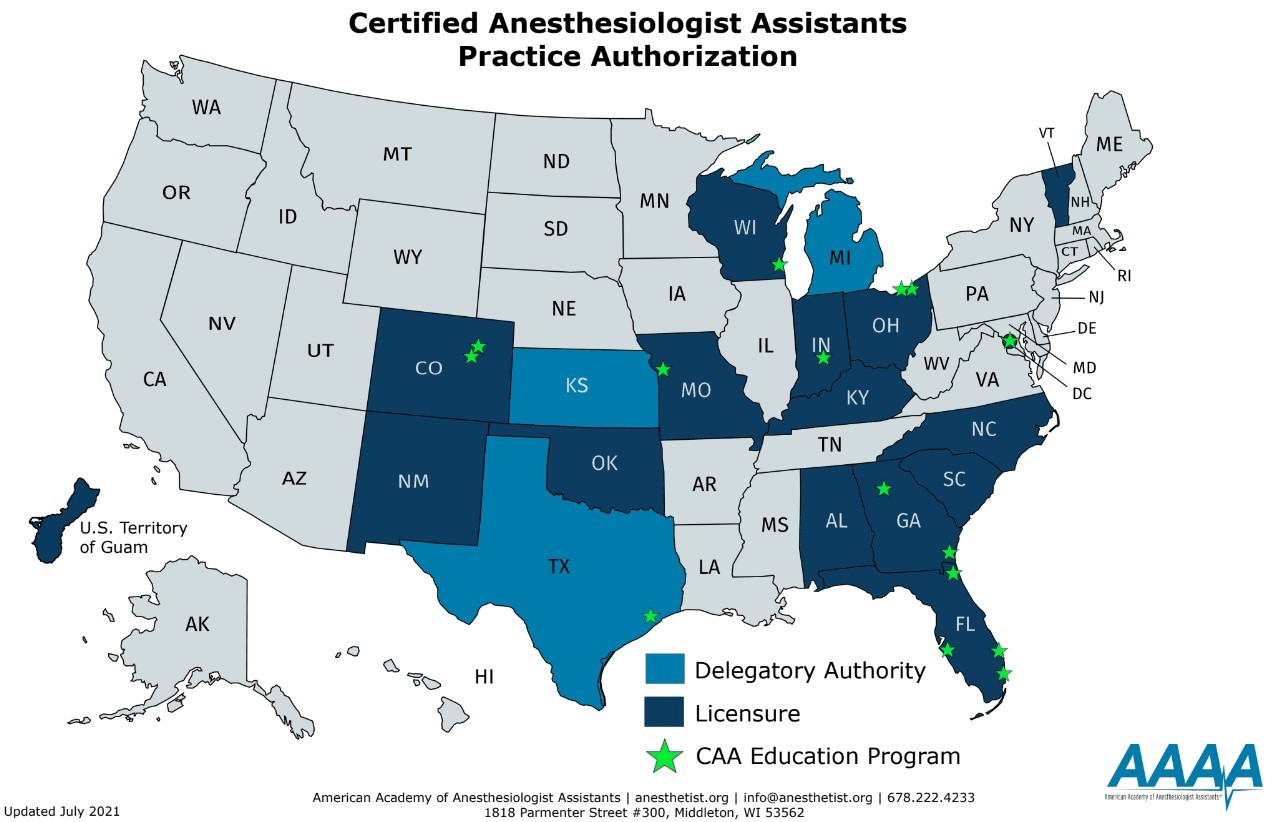
Since its inception, the Anesthesiologist Assistant profession has grown, though it remains a largely regionalized profession. This is due to the small but growing number of educational programs, which until 2004 numbered only two, and to the limited number of jurisdictions, 17, where certified anesthesiologist assistants are authorized to practice. In 1989, the National Commission for Certification of Anesthesiologist Assistants (NCCAA) was formed to establish a national certification process. Today, the American Society of Anesthesiologists considers Certified Anesthesiologist Assistants to be an advanced practice provider who work under the direction of a physician anesthesiologist and participate in the provision of anesthesia. Certified Anesthesiologist Assistants perform such tasks as administering drugs, obtaining vascular access, applying and interpreting monitors, establishing and maintaining patient airway, and assisting with preoperative assessment.
Certified Anesthesiologist Assistants enjoy a dynamic profession that continues to realize exponential growth as evidenced by the addition of new training sites and new states opening to CAA practice.